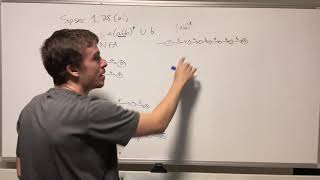
Topic Brief: This video is a supplement for students who are reading "Introduction To The Theory Of Computation" by Michael Sipser. Here we ponder the question about what is "necessary" for a state-based machine to recognize the concatenation of two

Regular Languages Nondeterministic Finite Automaton Nfa -

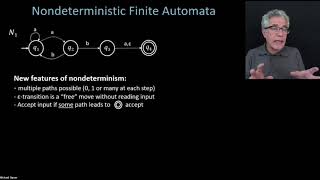
This video is a supplement for students who are reading "Introduction To The Theory Of Computation" by Michael Sipser. Here we ponder the question about what is "necessary" for a state-based machine to recognize the concatenation of two MIT 18.404J Theory of Computation, Fall 2020 Instructor: Michael Sipser View the complete course: ...

Important details found

  • This video is a supplement for students who are reading "Introduction To The Theory Of Computation" by Michael Sipser.
  • Here we ponder the question about what is "necessary" for a state-based machine to recognize the concatenation of two
  • MIT 18.404J Theory of Computation, Fall 2020 Instructor: Michael Sipser View the complete course: ...

Why this topic is useful

The goal of this page is to make Regular Languages Nondeterministic Finite Automaton Nfa easier to scan, compare, and understand before opening related resources.

Sponsored

Frequently Asked Questions

What should readers check next?

Readers should check related pages, official references, or updated sources when details matter.

Why are related topics included?

Related topics help readers compare nearby references and understand the broader subject.

What is this page about?

This page summarizes Regular Languages Nondeterministic Finite Automaton Nfa and connects it with related entries, references, and supporting context.

Image References

Regular Languages: Nondeterministic Finite Automaton (NFA)
Regular Languages: Deterministic Finite Automaton (DFA)
What is an Nondeterministic Finite Automaton (NFA)?
Regular Languages
Non-Deterministic Finite Automata
Formal Definition of Non-Deterministic Finite Automata (NFA)
Nonregular languages: How to use the Pumping Lemma
Regex to NFA Conversion Isn't Hard! (Sipser 1.28a)
5.3 DFA to GNFA to Regular Expression
2. Nondeterminism, Closure Properties, Conversion of Regular Expressions to FA
Sponsored
View Full Details
Regular Languages: Nondeterministic Finite Automaton (NFA)

Regular Languages: Nondeterministic Finite Automaton (NFA)

Read more details and related context about Regular Languages: Nondeterministic Finite Automaton (NFA).

Regular Languages: Deterministic Finite Automaton (DFA)

Regular Languages: Deterministic Finite Automaton (DFA)

Read more details and related context about Regular Languages: Deterministic Finite Automaton (DFA).

What is an Nondeterministic Finite Automaton (NFA)?

What is an Nondeterministic Finite Automaton (NFA)?

Here we ponder the question about what is "necessary" for a state-based machine to recognize the concatenation of two

Regular Languages

Regular Languages

Read more details and related context about Regular Languages.

Non-Deterministic Finite Automata

Non-Deterministic Finite Automata

Read more details and related context about Non-Deterministic Finite Automata.

Formal Definition of Non-Deterministic Finite Automata (NFA)

Formal Definition of Non-Deterministic Finite Automata (NFA)

Read more details and related context about Formal Definition of Non-Deterministic Finite Automata (NFA).

Nonregular languages: How to use the Pumping Lemma

Nonregular languages: How to use the Pumping Lemma

Read more details and related context about Nonregular languages: How to use the Pumping Lemma.

Regex to NFA Conversion Isn't Hard! (Sipser 1.28a)

Regex to NFA Conversion Isn't Hard! (Sipser 1.28a)

Read more details and related context about Regex to NFA Conversion Isn't Hard! (Sipser 1.28a).

5.3 DFA to GNFA to Regular Expression

5.3 DFA to GNFA to Regular Expression

This video is a supplement for students who are reading "Introduction To The Theory Of Computation" by Michael Sipser. I took the ...

2. Nondeterminism, Closure Properties, Conversion of Regular Expressions to FA

2. Nondeterminism, Closure Properties, Conversion of Regular Expressions to FA

MIT 18.404J Theory of Computation, Fall 2020 Instructor: Michael Sipser View the complete course: ...