Short Overview: In this mathematical appendix, we calculate how large the sample size needs to be if you want the margin of error to be +/- 3% ... Objective: At the end of this lesson, students will be able to: Given a margin of error and a sample statistic, find the confidence ...

The Math Behind The Polls -

In this mathematical appendix, we calculate how large the sample size needs to be if you want the margin of error to be +/- 3% ... Objective: At the end of this lesson, students will be able to: Given a margin of error and a sample statistic, find the confidence ... He is a mathematician who relies on equations and data to draw conclusions about how ...

Important details found

  • In this mathematical appendix, we calculate how large the sample size needs to be if you want the margin of error to be +/- 3% ...
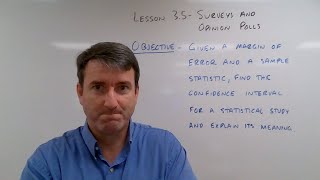
  • Objective: At the end of this lesson, students will be able to: Given a margin of error and a sample statistic, find the confidence ...
  • He is a mathematician who relies on equations and data to draw conclusions about how ...
  • This video provides a simulation approach to understanding sampling distributions and the Central Limit Theorem in statistics.
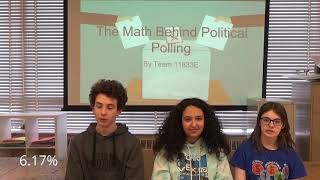
  • Team Members Sarah Hannah Nico Software Wondershare Filmora Google Drive Google Sheets Google Forms Interviews ...

Why this topic is useful

A structured page helps reduce disconnected snippets by grouping the main subject with context, examples, and nearby entries.

Sponsored

Frequently Asked Questions

Is the information always complete?

Not always. Some topics may need verification from official or primary sources.

How should readers use this information?

Use it as a starting point, then open related pages for more specific details.

What should readers check next?

Readers should check related pages, official references, or updated sources when details matter.

Reference Gallery
The Math Behind the Polls
The math behind the polls including sampling distributions with R
Election special - math and polls
College Math Lesson 3.5 - Surveys and Opinion Polls
The Math Behind Political Polling; By Team 11833E
Why Polls Can Be Accurate (Even When They Shouldn't Be)
Math Appendix: More Accurate Polls: What Won't Work
11833E's STEM Project: The Math Behind Political Polling
Colorado mathematician explains the data behind decision-making for voters
[Math] A political candidate has asked you to conduct a poll to determine what percentage of people
Sponsored
View Full Details
The Math Behind the Polls

The Math Behind the Polls

Read more details and related context about The Math Behind the Polls.

The math behind the polls including sampling distributions with R

The math behind the polls including sampling distributions with R

This video provides a simulation approach to understanding sampling distributions and the Central Limit Theorem in statistics.

Election special - math and polls

Election special - math and polls

With less than a week to the presidential elections, I take a quick look at how

College Math Lesson 3.5 - Surveys and Opinion Polls

College Math Lesson 3.5 - Surveys and Opinion Polls

Objective: At the end of this lesson, students will be able to: Given a margin of error and a sample statistic, find the confidence ...

The Math Behind Political Polling; By Team 11833E

The Math Behind Political Polling; By Team 11833E

Read more details and related context about The Math Behind Political Polling; By Team 11833E.

Why Polls Can Be Accurate (Even When They Shouldn't Be)

Why Polls Can Be Accurate (Even When They Shouldn't Be)

Read more details and related context about Why Polls Can Be Accurate (Even When They Shouldn't Be).

Math Appendix: More Accurate Polls: What Won't Work

Math Appendix: More Accurate Polls: What Won't Work

In this mathematical appendix, we calculate how large the sample size needs to be if you want the margin of error to be +/- 3% ...

11833E's STEM Project: The Math Behind Political Polling

11833E's STEM Project: The Math Behind Political Polling

Team Members Sarah Hannah Nico Software Wondershare Filmora Google Drive Google Sheets Google Forms Interviews ...

Colorado mathematician explains the data behind decision-making for voters

Colorado mathematician explains the data behind decision-making for voters

Zack Kilpatrick is not a political scientist. He is a mathematician who relies on equations and data to draw conclusions about how ...

[Math] A political candidate has asked you to conduct a poll to determine what percentage of people

[Math] A political candidate has asked you to conduct a poll to determine what percentage of people

Read more details and related context about [Math] A political candidate has asked you to conduct a poll to determine what percentage of people.